
VIRTUAL REALITY THERAPY
WHAT IS VIRTUAL REALITY THERAPY?
Virtual reality therapy is one of the truly cutting-edge forms of neurorehabilitation we use as part of your NeuroRescue Program. Research is exploding in the use of virtual reality to benefit all manner of neurological conditions. By introducing you to simulated environments, we can engage your visual, vestibular, and proprioceptive systems in a series of tasks that simulate real-world challenges.
Virtual reality therapy allows us to help you learn to overcome those challenges in a safe, controlled environment. Virtual reality serves as a transitional step between the clinical environment and the outside world. It helps ensure that the gains you make in you NeuroRescue Program translate to the improved quality of life you deserve.
HOW DOES VIRTUAL REALITY THERAPY HELP ME?
Virtual reality technology has evolved to the point where it is now possible to simulate extremely realistic virtual environments. The ability to function in these environments requires the integration of almost all of the same sensory systems as you use in the real world. The same visual, vestibular, and many of the proprioceptive inputs you use to move around in reality are needed in a virtual space.
In many neurological conditions the ability to integrate these inputs fails, leading to sensory mismatches and conflicts that give rise to unwanted symptoms. Many people with neurological disorders find that they can function relatively well when they are in controlled, familiar environments with limited sensory input. But when they venture out into the world, the complicated visual and auditory environments they confront can be very challenging and overwhelming. This can lead to flares of symptoms ranging from dizziness and headaches to anxiety and panic attacks.
Virtual reality exercises allow us to carefully introduce you to these environments again, but in an extremely controlled manner. We can begin with a limited level of visual and auditory input, and give you tasks to complete within these virtual spaces. As your brain masters them and learns to properly integrate the input from the environment, we can progressively increase the sensory challenge, and do so in a way that is designed to specifically rehabilitate your neurological challenges. We find that this approach is very helpful to improve the ability of our patients to function in the world without symptoms or stress. Virtual reality exercises have been shown in research to benefit a wide range of neurological conditions. The ever-growing list of conditions VR has been shown to help include:
Concussions and Traumatic Brain Injuries | Dizziness and Vertigo | Headaches and Migraines | Neurodegenerative Disorders | Chronic Pain | Movement Disorders | Neurodevelopmental Disorders | Dysautonomia | Strokes and Vascular Disorders | Peripheral Nervous System Disorders | Mental Health Conditions
WHAT TO EXPECT:
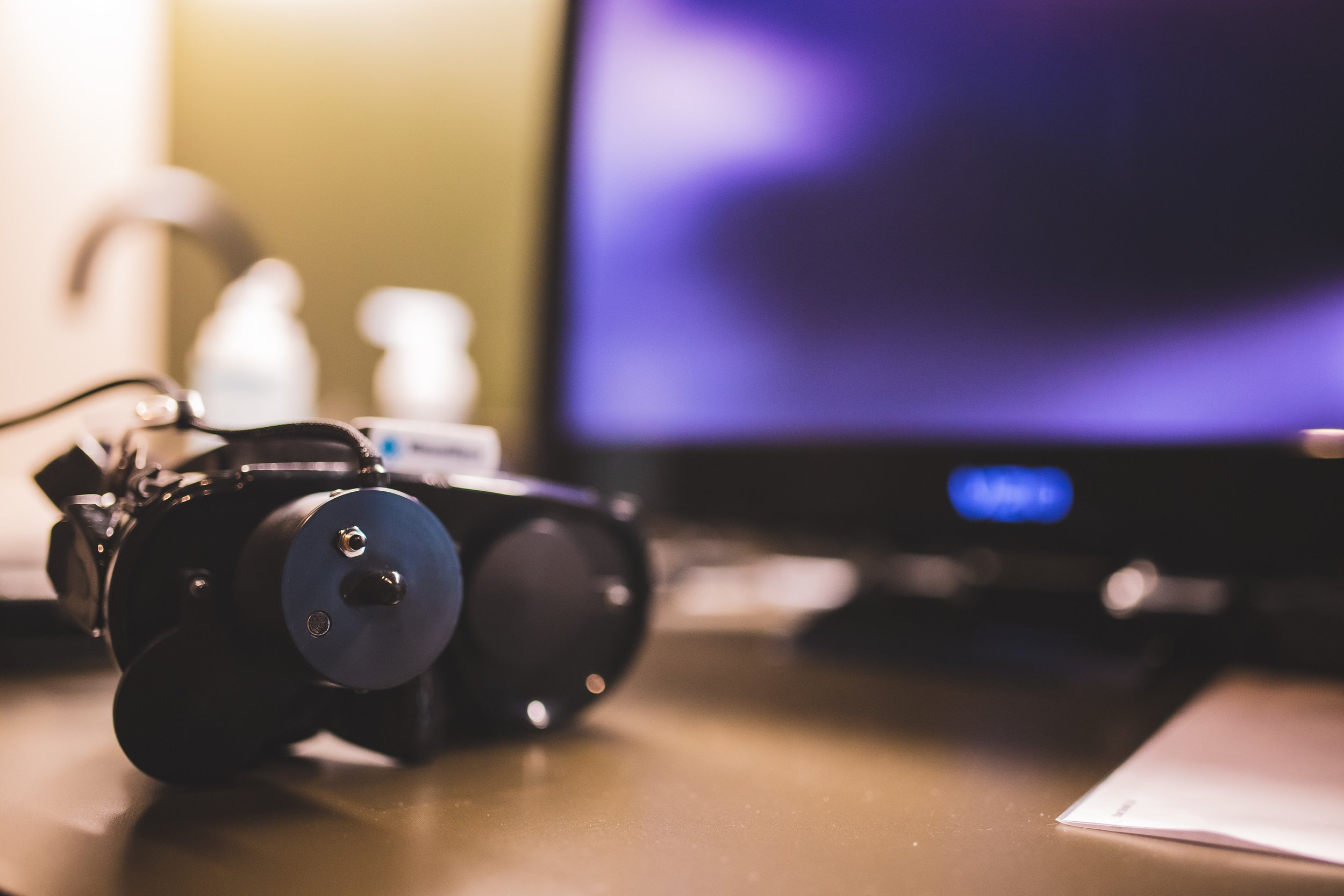
We use the Virtualis VR system, one of the most advanced clinical virtual reality systems available today. In our virtual reality suite, you will wear a headset with headphones, and will hold a set of controllers. The computer will simulate extremely realistic environments for you to move about in and interact with. You can walk around in the virtual space, as well as touch and manipulate virtual objects.
FAQs
-
Yes, entirely. We always have a staff member with you at all times to ensure that you do not inadvertently bump into anything in the real world as you manipulate your virtual environment. Your therapist will be monitoring your performance to determine when you begin to fatigue, and will adjust or stop your exercises accordingly.
-
There are several different types of exercises we employ depending on the needs of your condition. For example, many people that have suffered concussions and mTBIs struggle with keeping their eyes and head synchronized while they follow moving targets. In these cases, we often use an exercise where they see a target circle that represents their central visual field. They are placed inside a virtual star field, and are tasked with tracking a moving planet by keeping it within their visual target circle. Other exercises involve manipulating objects with their virtual hands, or mirror images of their hands. Still others involve visually scanning a wall of virtual balloons, and popping ones with specific colors.
The Virtualis system includes extremely lifelike and detailed simulations of shopping malls, escalators, moving sidewalks, subways, traffic intersections, driving cars, and even outdoor elevators. You are able to move around in these environments and manipulate virtual objects with your controllers.
Learning to master these challenging environments in a safe, progressive manner can go a long way towards helping you regain mastery of your activities of daily living, so you can get back to living the life you deserve.
-
As an example, when people struggle with dizziness and vertigo, whether as a primary condition or the result of an injury like a concussion, going grocery shopping can feel like a descent into hell. The task of scanning an extremely complicated visual environment while you move through the aisles filled with moving people is an extremely challenging neurological task. This can become an impossible one for patients struggling with dizziness and vertigo. Often the mere thought of going grocery shopping can be enough to provoke anxiety and even panic attacks. This can continue to be the case even after the dizziness and vertigo has been rehabilitated.
Our Virtualis system contains an extremely lifelike virtual grocery store, wherein we can safely and gradually reintroduce this activity. You can walk around in the space, reach out and grab objects from the shelves, and put them in your virtual basket. The aisles are filled with other shoppers that you need to navigate around. We include working memory challenges by giving you a shopping list to memorize, and you go off to search for your items. We can make the environment progressively more complicated as you master the tasks, with longer lists and more people to avoid.
Shopping involves very high levels of neurological processing. It requires accurate eye movements as you look through the shelves. It involves gaze stabilization reflexes and integrates eye movement with head movement as you scan the environment, and translational vestibular reflexes as you move through the aisle. The extremely complicated visual environment increases the challenge, more so with all of the other shoppers moving through the space. This would be more than enough, but the cognitive load that comes with attempting to manage a shopping list is frequently enough to push people over their functional edge.
With our Virtualis VR grocery store, we are able to manipulate every variable of a shopping task. This allows us to find the threshold where the task is challenging without provoking your symptoms, and gradually increase the level of challenge as you build neurological stamina. This helps us bridge the gap between performing well in the clinic, and mastering life in the outside world. VR therapy is thus often a critical component in your NeuroRescue Program.
-
No.
LET’S GET YOU BACK TO LIVING YOUR BEST LIFE
“Dr. Z has been such a great help for our daughter. She suffered migraines and vertigo from a car accident for two years. She saw many specialists with no help. Dr Z was excited about her puzzling brain and he had the migraines and vertigo fixed in a week. She is still working on several small things but we have our daughter back. He’s the best and we would highly recommend him to anyone with neurological issues.”
-
We use advanced neurodiagnostic technologies and cutting edge neurorehabilitation strategies that are unique to your brain and condition.
-
We use high frequency treatment over 5-10 days, to bring you maximum results in the shortest time possible.